Category Archives: Consent

What is the cost of active RFID UWB tagging students at West Cheshire College?

You’d have though some simple questions on cost and funding may have been easy to answer, especially when you are investing in a state of the art, military standard, ultra wideband RFID tagging system for tracking children in real time?   It would seem not.

UWB RFID tracking students at West Cheshire College

West Cheshire College, according to the RFID Journal, started tracking students in 2010 with active RFID tags emitting a radio frequency signal, over 300 feet every second, to sensors around the college to pinpoint the students position to an accuracy within 1 meter – featuring some of most sophisticated RFID capabilities on the market. 

According to the college, the Chief Executive/Principal, a role held by Sara Mogel, was responsible for the New Buildings project at the College under which the RFID tracking system was installed.   So great a return on investment the RFID system proved to be, that the college’s Business Area Services Manager, Kevin Francis, went to Florida, USA, in April 2012 to give a presentation at an international RFID conference of how successful UWB RFID was at tracking kids.

So how much does this cost the British tax payer and how was the RFID and was funded?   To cut a very long exchange of  Freedom of Information Request (FOIR) and West Cheshire College’s replies short (which can be read here) apparently this is how a state of the art RFID student tracking system is procured at one of the UK’s largest Further Education colleges: 

Finance – West Cheshire college cannot be clear if the system was purchased, if it was purchased they cannot  find the cost.  The word “impossible” was used.

Implementation  – The college does not hold nor can provide any documents or records whatsoever on any discussions about the implementation of the RFID system.

Supplier – The college claim they have had no contact with the supplier,  Zebra Technologies, at all.   Zebra had on their website a videoOptimising the learning experience with a Zebra Location Solution” of the college, staff and students promoting the real time student tracking system.   This would seem to highlight that a company can film the college, staff and students without contact with the college at all.

Lack of Information – Members of staff that have left have been cited as a reason for the college not being able to provide information under its obligation to the Freedom of Information Act.  

Staff trip to Florida – West Cheshire College hold no documents or records about sending a member of staff to another continent to present the college’s use of UWB RFID to the RFID industry.  The college states that “In such cases there are no costs presented to the college and all matters are settled by the sponsors.”   Does this apply to this case/trip?  They have no documents on it either way, so maybe not?  Who knows?
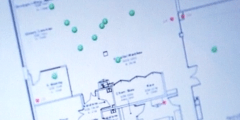
Against RFID in schools

Student Consent and privacy -The college cannot be clear on how consent from students has been gained, whether any privacy impact assessments have been carried out.  They could not be clear on the specification of the RFID used to track the students.  These unanswered questions on consent and privacy, asked under the Freedom of Information Act, are now lodged  as an official complaint with the Information Commissioner’s Office.

Either West Cheshire College’s understanding of the Freedom of Information Act is extremely poor or the college’s answers under the Freedom of information Act raise some serious questions about what is going on at the college as a whole.  If West Cheshire College’s responses under the Freedom of Information Act are to be believed – which they must as the college has obligation under the law to respond truthfully – then practices at the college appear to highlight serious breaches of student consent, privacy, audit trails, accountability, transparency and security.  This would be quite astonishing.

The seriousness of child/student welfare should be of absolute paramount concern to any educational establishment acting in parentis locus and replies given under the Freedom of Information Act must be taken seriously – to this extent the Information Commissioner’s Office who oversees the Freedom of Information Act and Data Protection Act has been made fully aware of this situation.

We will let the penultimate slide of Kevin Francis’s presentation to the RFID Industry last April 2012, sum up:   “West Cheshire College – a first in the Education sector”

RFID – Schools must “consult fully with parents and pupils”

There is no law against tracking people in the UK however in order to do so the person who is being tracked must give Data Protection Acttheir consent for the tracking to be legal.

In the UK Schedule 1 of the Data Protection Act 1988 (DPA) states that “Personal data shall be processed fairly and lawfully” .  One aspect of lawfully processing data is the area of consent, covered in Schedule 2 of the DPA.  The first point in Schedule 2 is that the Data Controller (the school) has to gain the consent of the Data Subject (the pupil) in order to process information about them. “The data subject has given his consent to the processing.”

Tracking children in education with a real time location system (RTLS) using RFID tags absolutely falls under this legislation.

An email received from the Department of Education states the following:

Thank you for your email of 1 January 2013 addressed to the Secretary of State, with enclosures, about the implications of the use of Radio Frequency Identification Technology.  I have been asked to reply. [Case Ref 2013/0000789]

As you will be aware, schools and colleges are Data Controllers in their own right, and as such, must comply with the data protection principles set out in the Data Protection Act 1998.  For example, the first data protection principle requires that personal data must be used fairly and lawfully and that one of the conditions in Schedule 2 to the Data Protection Act must be met.  These include: obtaining the consent of the data subject; compliance with legal obligations; performance of contractual obligations; and the processing being necessary for the purposes of legitimate interests of the data controller.  I understand from your email that you have also been in contact with the Information Commissioner’s Office (ICO) and I would suggest that the ICO would be the appropriate body for advising on the particular case you have pursued.

As with the introduction of parallel systems such as CCTV, this Department would look to schools and colleges to consult fully with parents and pupils before implementing this kind of technology.

UK Department of Education – tracking children in education with RFID:

“…schools and colleges to consult fully with parents and pupils before implementing this kind of [RFID] technology“.

West Cheshire College stops tracking students with RFID

West Cheshire College, UK, have stopped tracking their students with active RFID tags since using the technology from 2010.
Active location tracking RFID West Cheshire College

On the 26th of February a complaint was made to the Information Commissioner’s Office (ICO) concerning the college’s refusal to answer a Freedom of Information request about consent and civil liberties regarding using active RFID tags to trace students movements around West Cheshire College campuses at Handbridge and Ellesmere Port.

On 27th February the college states they do not use the RFID:  As the trial has now concluded, all RFID tags are inactive and have been recalled.” 

On 18th February West Cheshire College, in an FOIR reply, appears still to be using a student RFID location system and on 27th February, 9 days later, the college states it has ceased using the ultra wideband RFID location system.

A RFID system so excellent that the college sent an employee to Florida last April, 2012, to lecture the RFID industry on the Return On Investment (ROI) the RFID provided for the college (see 2pm on April 5th).  However there are unanswered Freedom of Information requests regarding how the RFID was funded, if indeed the college has ever paid for the system.  This then presents the question as to why would West Cheshire College send an employee to Florida, USA, to lecture the RFID industry on a new ultra wideband RFID standard on a return on investment that the college never invested in?

From West Cheshrie College presenting a Return On Investment (ROI) presentation in April 2012 in Florida, to scrapping it in February 2013 it would seem the college has also scrapped all information whatsoever on the groundbreaking industry standard RFID  they have had in the college since 2010.

On the 27th February 2013, a day after a complaint to the ICO, West Cheshire College offered a late reply to the Freedom of Information request asked on 10th December 2012 regarding consent and civil liberties.  After the college did a “search for information” it can uncover “no information” at all on how consent was gained from students, whether the college did a Privacy Impact Assessment to access the RFID or how the college could use a RFID for registration when “The technology is not used for tracking of individual students“.  Maybe that is why the RFID was scrapped – how can a system that does not individually track children work for registration? …and it took them 2 years to come to that conclusion?  (Really?)  There are anomalies in all this that seem not to add up.

One could draw an opinion that West Cheshire College are evading questions on why an unstandardised active RFID location system has been used to track children for over 2 years.  There are unanswered questions on how consent was gained and how the college, days after scrapping the technology, seem to have completely expunged all records of the ultra wideband RFID and in fact have no evidence of the RFID real time location system used there.

The Information Commissioner’s Office is now handling the complaint of how West Cheshire College managed their legal obligation to give information under the Freedom of Information Act.  This active type RFID technology has the capacity to be used covertly and the potential for lack of transparency by educational establishments using a real time location system is completely plausible.

Contactless RFIDDifferent people have differing levels of privacy.  If you or your child are wearing or carrying a card or tag that communicates remotely to a system and you have concerns how ‘smart’ or ‘contactless’ technology works – ask questions.  We all know data gathering is vast in today’s age.  Making sure you are aware of who is accessing your data is prudent, none of us truly know where our information may end up, who views it and how it may be used for or against us.

Transparent RFID policy and consent

In January 2011 the EU document ‘Privacy and Data Protection Impact Assessment Framework for RFID Applications’ was published. The document is an industry-prepared framework for Personal Data and Privacy Impact Assessments of RFID Applications and endorsed by the Article 29 Data Protection Working Party.

RFID Privacy targets include “Compliance with the data subject’s right to object –  It must be ensured that the data subject’s data is no longer processed if he or she objects.” along with one of the concerns of the privacy risks being Invalidation of explicit consentConsent has been obtained under threat of disadvantage.” – see pages 13 and 15.   However, this EU document is only advisory and simply details good practice with no set enforcable regulated code of practice yet in place for RFID tracking people.

In a recent article it came to light that in the UK a 14-19 college, West Cheshire College, are using RFID tags for registration purposes but then oddly state the information the RFID give them will be anonymised.  Quite how they plan to register individual students with anonymised RFID tags is baffling but, more worryingly, the college seems to have adopted a ‘must wear’ attitude.

In order for students to be able to object, as detailed the above EU document, to this level of surveillance, where staff at educational establishments such as West Cheshire College are able to  “look at them in groups, such as peer groups.”, both students and staff tagged need to be fully informed of exactly what the RFID chips they carry are being used for. i.e. how and where people would be tracked and the personal information held.

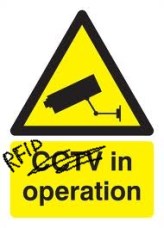
rfidcctvsignThis communication of the college’s intent of RFID use to register its students and staff, and subsequent consent, presumably would need a little more than a verbal statement.  Indeed, a document detailing the college’s RFID policy and a Privacy Impact Assessment would surely be considered good practice.

Maybe an adoption of the CCTV industry’s code to inform persons of CCTV tracking by signage on walls in areas where surveillance is occurring should be considered where RFID real-time location systems are in operation?

This would go some way to ensure transparency for those choosing to carry RFID tags.

UK students “must wear” RFID tags

In West Cheshire College, Cheshire UK, Students [are] made to carry ‘Orwellian’ locater tags – College staff and students have been issued with compulsory electronic badges that are capable of tracking their movements, leading to criticism of “Orwellian” tactics.”

How exactly does an establishment implement compulsory RFID tagging and still give the persons being tagged an option to consent?
RFIDconsent
If such a RFID tagging scheme can be compulsory and written consent is not gained from students what is to stop colleges and schools issuing RFID tags and not informing students? If a system is compulsory, presumably there is no room for non participants therefore no room for people to be able to make a choice in this matter, i.e. to consent.

Are persons not consenting then to write and ‘opt out’ of the RFID real time location system?  Perhaps we in the UK are to see a repeat of the much criticised line the educational establishments took with taking children’s biometrics without parental consent, deemed to be such bad practice that parental consent is now needed by law for schools to take and process children’s biometrics up to the age of 18.  This law is contained in the recent Protection Of Freedoms Act  2012.  West Cheshire College caters for pupils 14-19 year olds.

Then there is the issue of possible discrimination that could accompany a “must wear” policy the college has for those not wearing RFID tags.

Certainly as a parent I would want to know exactly who was watching my under 18 child at college in real time and why and where would they be monitoring their movements, to the toilet, school showers?   And I would not be happy with any discrimination my child may experience by not being RFID tagged, if indeed the college would enrol or employ a person refusing to wear RFID.

Just what are the college looking at?   In the RFID Journal, Kevin Francis, West Cheshire College’s Building Services Area Manager, states: We can search for individual [students or staff]. And we can look at them in groups, such as peer groups.”  [NB. This RFID Journal article was withdrawn from the RFID Journal’s website w/c 7 Jan 2013.  A Copy of the article (pdf) is here and here is the original article on the Internet Archieve Wayback Machine] Then to the Telegraph: “We do have these tags, but they’re not for the purposes of tracking.”

Erm, yes they are.  RFID tags track.  Why else would West Cheshire College purchase a RFID ‘real time location tracking solution’?  [ NBZebra Technologies withdrew the article from their website late February/early March 2013. A copy of the press release (pdf) is here  and this is the Internet Archive Wayback Machine’s link to the original webpage]

Then comes the sell.  Environmental – “The aim is to use the buildings as efficiently as possible.”  Security – “We are interested in teaching and learning, building use and the security of
students and staff.”… oh yes and here comes safety – “Staff with first aid training can be identified if needed in an emergency.” and not to forget funding – “we use this information for funding purposes”.  There we go.

The use of RFID may be about many issues but the issue surrounding consent, both for pupils, parents and staff, here is the most serious.

How can a compulsory RFID tracking scheme involve consent?