Tag Archives: RFID children

RFID – “It’s going to make you sick.”

nav-logo-small-newAt the Texas House of Representatives House Bill 101 was heard yesterday, 19th March 2013.  The audio/video can be found here 2 hours 45 minute in.

From My San Antonio – Andrea Hernandez, one of the students that refused to carry the tracking RFID and was subsequently expelled from John Jay High School, ” told legislators Tuesday that she became ill because of radiation from the tags in other students’ IDs.
 “It’s like being in an X-ray machine for eight hours,” Andrea Hernandez said. “It’s going to make you sick.”” 

Incredibly the vendor of the active RFID 433MHz tags that the students wear, Michael Wade, stated that “said they [RFID tags] do not produce any radiation. – “None at all,” he said.”

…move along people, clearly nothing to see here then?

Michael Wade is uninformed.  Radio frequency is electromagnetic radiation.   The following is taken from this EU document “Is RFID safe in the workplace” and talks about the effects of RFID radiation.

Radio communications and microwave frequencies are known as radiofrequency, which fall within the kHz to GHz range.  In the case of RFID, the frequencies used are in the order of 145 kHz, 13.56 MHz, 800-900 MHz and 2.4 GHz.  There are two different kinds of electromagnetic radiation. Depending on their major effects, electromagnetic fields can be divided into ionizing radiation and non-ionizing radiation.  As radiofrequency photon energy up to 300 GHz is not high enough to break these bonds, these kinds of electromagnetic fields are known as Non-Ionizing fields. Fields with frequencies above this limit are known as Ionizing Electromagnetic Fields.  (433MHz tags used at John Jay)

Ionization is a process that breaks the atom-electron bond, thus creating molecules without sufficient electrons to achieve a neutral charge. This causes molecular changes that may produce biological damage, including changes in DNA.

Also this article from the World Health Organisation about mobile phone frequencies, 450 and 2700 MHz, operating near the 433MHz RFID tag frequency that John Jay High use.

Radio frequency radiation and health effects is too large a topic to be covered here in any depth but there is a mounting body of evidence to suggest that electromagnetic frequencies can have an effect on health – this is from radiation.  So statements from RFID vendors, that could be described as misleading and uninformed, need a little more research.  The health effects of active and passive RFID are known.   With good evidence to suggest radio frequencies can harm humans, here are just a handful of excellent websites dealing with this topic:

Contactless RFIDhttp://www.radiationresearch.org/
http://stopsmartmeters.org/
http://www.wifi-in-schools-australia.org/
http://wiredchild.org/

Unfortunately these frequencies are invisible and we have no knowledge of what we are accumatively exposed to.  Therefore eliminating one less potential health hazard from our lives by not wishing to carry an active RFID tag could considered a prudent action to take.

So though individuals may choose not to consent to using RFID due to personal, spiritual, privacy/civil liberties concerns, it may appear that there is no choice whether or not to participate in the electrosmog that comes from others use of, RFID, radio frequencies technologies.

Discussion from the Public Forum on Student Location RFID

USA, Texas – Over on the We Are Change Texas YouTube Channel is the public discussion from last Monday’s RFID Forum, run by Texans for Accountable Government with RFID privacy expert and activist Dr Katherine Albrecht speaking about the RFID Student Locator Pilot Programme run by the Northside Independent School District in two schools John Jay High School and Anson Jones Middle School.

The school’s superindent and board were invited to attend, as was the vendor.  The school board declined and the vendor unfortunately got sick at the last minute.  Dr Katherine Albrecht was interviewed on the Alex Jones Show and revealed the following – The Northside Independent School District’s attitude was that the RFID scheme was done, a done deal.  Dr Katherine Albrecht then attended a city council meeting later in the day, had her name on the list to speak at the meeting and got told, when at the meeting by the school board, that she would not be allowed to speak.  (A repeated behavior by the school board, previously shown at a meeting in September 2012, where parents had little or no right to comment on the RFID scheme.)

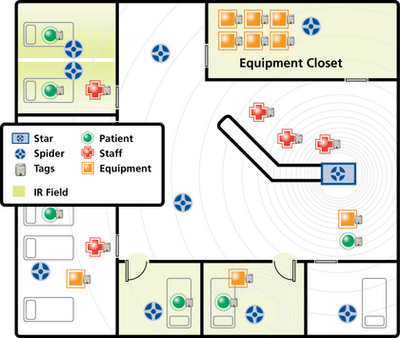
At these two US schools there are at least 4,200 students wearing RFID tags round their neck with a Radio Frequency pulsing every 45 seconds emitting up to 75 feet.  This frequency is at 433MHz, which is near/just about in the Amateur Radio Frequency and a frequency commonly used for remote keyless entry.  433Mhz is an unliscenced industrial, scientific and medical (ISM) radio band and a simple internet search for 433MHz antenna/receiver shows how available this technology is to buy.  (The UWB location RFID at a UK College recently using a Real Time Location System (RTLS) pulsed at a 1 second interval at 6.35-6.75 GHz on an ultra wideband Radio Frequency for up to 100 feet.)

Andrea Hernandez, a 15 year old John Jay High School student, refused to wear a RFID tag and also refused to wear a dummy tag and as a consequence was barred from her school.   A gutsy stand by Andrea and supporters, upholding up her personal principles, did not convince a court decision on the matter of her still attending John Jay High School without a RFID Locator Tag and sadly in Andrea’s instance, a refusal to participate in an RFID scheme resulted in discrimination against her schooling options.  However there are now three Bills introduced in Texas Legislature dealing with RFID tracking students “Where a schools district may allow voluntary use of RFID – Schools districts must provide an alternative identification” or even that “A school district may not require a student to use a RFID device or similar technology to identify the student, transmit information or track the location of the student

This recent public forum was opportunity to ask questions, voice concerns, discuss responsibilities, privacy and civil liberties of RFID location tracking, potential health issues of RFID and to keep the debate in an open, honest format.  Hopefully the prejudice that Andrea has experienced will not have to happen to another individual not wishing to participate in any location tracking device.

A shame that school representatives and the vendor could not attend.  I suspect their absence spoke louder than any discussion they may have brought to the forum.

Here is the first part of the debate.  The rest of the debate is on the We Are Change Texas YouTube Channel – thank you to them for sharing this.

Missouri bill proposes prohibiting RFID in schools

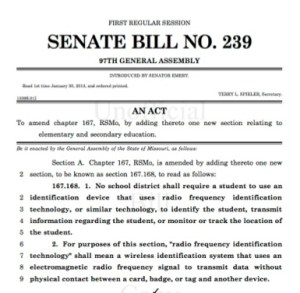
Missouri SB239USA –  Missouri Education Watchdog reported that Senator Ed Emery filed “a bill in Missouri that would not allow such practices as RFID tracking of students or Polar Go Fit bracelets for tracking information.”

The Bill SB239Prohibits school districts from requiring a student to use an identification device that uses radio frequency identification technology to transmit certain information’

This bill joins the other three current bills in Texas put forward prohibiting the use of RFID with children/students in US schools.

Three US state lawmakers introduce bills to ban RFID in schools

Northside Independent School District’s expulsion of student, Andrea Hernandez, this month has demonstrated how RFID application might save school dollars but clearly does not work in the fact that it has affected one students education.  Has it really been worth the saving in money the schools district claims will happen in the light of the fact John Jay High school discriminated against a child for refusing to take part in the RFID programme.?

With the religious, privacy and ethical issues involved here we look forward to seeing how the debate goes with the below bills filed in Texas recently that would prohibit RFID in state schools.

We have this technology and we cannot undo the technology but we need to use it responsibly and respectfully – which is why an open and honest debate is required.

TexasHB101 – introduced by Rep. Lois Kolkhorst and Rep. Cindy Burkett in November 2012
– Where a school district may not require a student to use a RFID device or similar technology to transmit information about the student or track the location of the student.
– Where a schools district may allow voluntary use of RFID
– Schools districts must provide an alternative identification

HB102 – introduced by Rep. Lois Kolkhorst and Rep. Cindy Burkett in November 2012
– A school district may not require a student to use a RFID device or similar technology to identify the student, transmit information or track the location of the student.

SB173 – introduced by Senator Craig Estes in January 2013
– A school district may not require a student to use a RFID device or similar technology to identify the student, transmit information or track the location of the student.

From My Antonio – Kolkhorst said she thinks the Legislature needs to debate the appropriateness  of that use, which she hopes will happen now that Northside’s pilot program has  drawn scrutiny.  Kolkhorst said her bills on the issue in the past haven’t been able to make  it out of committee.

I am concerned that this technology can be very dehumanizing,” Kolkhorst  said. “I really don’t like how parents don’t have much input and think it is an  example of government overstepping its bounds.”

“And we can look at them in groups, such as peer groups.”

According to an article from April 2012 in RFID Journal, [NB. This RFID Journal article was withdrawn from the RFID Journal’s website w/c 7 Jan 2013.  A Copy of the article (pdf) is here and here is the original article on the Internet Archieve Wayback Machine] West Cheshire College are RFID tracking 5,500 full-time students and have been doing so since 2010.

After the opening of its new campus at Ellesmere Port, Liverpool, the college “has successfully implemented Zebra’s real time location tracking solution with the ability to track and increase the visibility of 20,000 students across its two campuses” states Zebra Technologies, the US company who supplies the RFID tracking system.

Kevin Francis, West Cheshire College’s Building Services Area Manager, uses an interesting choice of language on Zebra Technologies website  [ NBZebra Technologies withdrew the article from their website late February/early March 2013. A copy of the press release (pdf) is here  and this is Internet Archive Wayback Machine’s link to the original webpage] to describe the college’s reasons for buying the technology – using the terms “asset tracking”  and  “optimizing our learning resources.” (referring to the students presumably?) with “specialist location solution capabilities” .  Are these phrases we may be hearing more of as other schools follow suit?

This all boils down to funding, states the RFID Journal :

“…the school also plans to utilize the RTLS [Real Time Location System] solution to reliably, quickly and accurately track student attendance, and to document that each student’s attendance record matches the actual number of hours for which the college receives funding (a process that is currently manual and time-consuming).”

It could be argued that an alternative method, other than RFID tagging students, could be found that would not be manual and time consuming.  An alternative, less invasive attendance system could be implemented, one that does not involve the college’s knowledge of each students every move.

The accurate attendance of students and the financial rewards that may reap from RFID tracking pupils is not the college’s only reason for locating the students and staff in real time, as Kevin Francis states to the RFID Journal:

Francis says this software will provide “reports if [students or staff] are leaving early,” stating,
“We can search for individual [students or staff]. And we can look at them in groups, such as peer groups.”  (Why?)

The privacy implications for the use of RFID technology constantly tracking a persons every move are massive, possibly insidious and very much open to abuse.  Clearly, as stated by Kevin Francis in the RFID Journal’s article, West Cheshire College will not just be monitoring attendance levels but will also be looking at individual associations.  The technology will reveal where students are with Real Time Location Systems.

How will this affect student and staff behaviour?  Trips to the toilet – been there too long?  Too many visits to a school nurse?  Student/staff relationship?  Students relationships?  Who has access to this information?

This RFID technology tracking humans in real time certainly raises more questions, than solutions it provides.