A college in the UK, West Cheshire College has a new industry standard Ultra Wideband RFID Real Time Location System used to monitor students in the college.
The RFID tracking scheme is proving such a success that Kevin Francis, West Cheshire College’s Building Services Area manager, travelled to Florida in April 2012 to speak about the Return Of Investment (ROI) the RFID tracking system gives the college at a ‘RFID Live!’ conference.
Interestingly, information from West Cheshire College about its RFID student tracking system does not flow quite as freely here in the UK . West Cheshire College’s response to recent Freedom of Information requests about the RFID location technology, and how it is used, could be considered patchy at the least.
The following questions were asked on January 3rd 2013 under the Freedom of Information Act. A simple ‘confirm’, ‘not confirm’ or ‘not know’ was required from West Cheshire College. The points raised in the questions were all reported in the media the college had communicated with.
Not particularly difficult then?
1) Please could West Cheshire college confirm if the below details* are correct and that these are the characteristics of RFID tags the students use:
* Ultra wideband RFID tags emit brief radio frequency signals across the entire 6.35 to 6.75 GHz frequency band.
* Average battery lifespan of a RFID tag is seven years.
* Receivers, which can receive tag signals from up to 328 feet away, are located throughout the campus buildings, in order to ensure that the tags can be pinpointed no matter where within the school a student might be located.
* RFID tags provides accuracy within 1 meter (3.3 feet).
* RFID Tag transmission rate of once per second.
* West Cheshire College uses RFID with a real time location system.
* The real time location system enables observation of student and staff in peer groups.
If any the RFID detail above is not correct please could you advise accordingly how the RFID used differs with the above points.
3) Please could West Cheshire College confirm if the following is correct:
* West Cheshire College deployed RFID technology in two phases — first at its Chester Campus, in 2010, and then at its newly built Ellesmere Port Campus in 2011*
West Cheshire College wrote back refusing to answer the above saying that “Under section 14(2), public authorities do not have to comply with repeated requests for the same information from the same person. In reaching a jugement, we have found that your request for information in [above]questions 1 and 3 were a repeated request to the one submitted to the College on 23rd November 2012”.
Now we are having problems seeing quite where and how the college replied to the above questions in the below answers they gave to the Freedom of Information request on 23rd November. If anyone can clarify what we have missed, please let us know. We simply would like to see the information.
1) Does West Cheshire College or any associated campuses use radio frequency identification (RFID) tags with students.
A: We introduced RFID on a trial basis to assess how the technology could be used for automatic registration of students and to improve the efficiency of the building.
2) What are these RFID tags used for? Please detail the applications. I.e. attendance, cafeteria, libraries, etc.
A: We are currently trialling the technology for the purposes of automatic registration of students and to improve the efficiency of the building. We are also trialling the technology for tracking the movement of physical assets i.e. ipads, laptops and camera equipment. The technology is not used for tracking of individual students. A decision as to the future use of the technology will be made at the end of the trial period (this is expected to be completed in March 2013).
[N.B. Quite how “automatic registration” happens without the “tracking of individual students” prompted another Freedom of Information request, sent to West Cheshire College 10th December, and included this point to be clarified. West Cheshire College wrote back refusing to answer.]
3) How many students carry RFID tags.
A: All full-time students (2000) were issued with RFID tags as part of the trial.
4) Please provide any literature given to students informing them of RFID tags use within the college and its campuses.
A: Information relating to the RFID tags and their purpose was covered during College induction/ enrolment.
West Cheshire College’s staff, whose salaries are paid for by public money, have bought a RFID tracking system, with public money. The RFID, thought to be the first of its kind in the UK, is bought and paid for by us, the British public. Strange then how West Cheshire College refuse to answer perfectly legitimate Freedom of Information requests about how they have spent our money – but yet will communicate, to the point of sending member of staff to another continent, to speak to the RFID industry about the RFID Real Time Location System they have.
If this RFID technology is so great a Return On Investment, why not tell us how our UK taxpayers money has been spent? Why there is no mention of it on West Cheshire College’s website? Or even why, at the very least, there is no declaration of the RFID tracking system to monitor students movements on their entry on UK’s Data Protection Register ?
Yet again, more questions than there are answers.

 Here is a short 2 minute promotional video of the RFID system, thought to be the first of its kind used in education in the UK.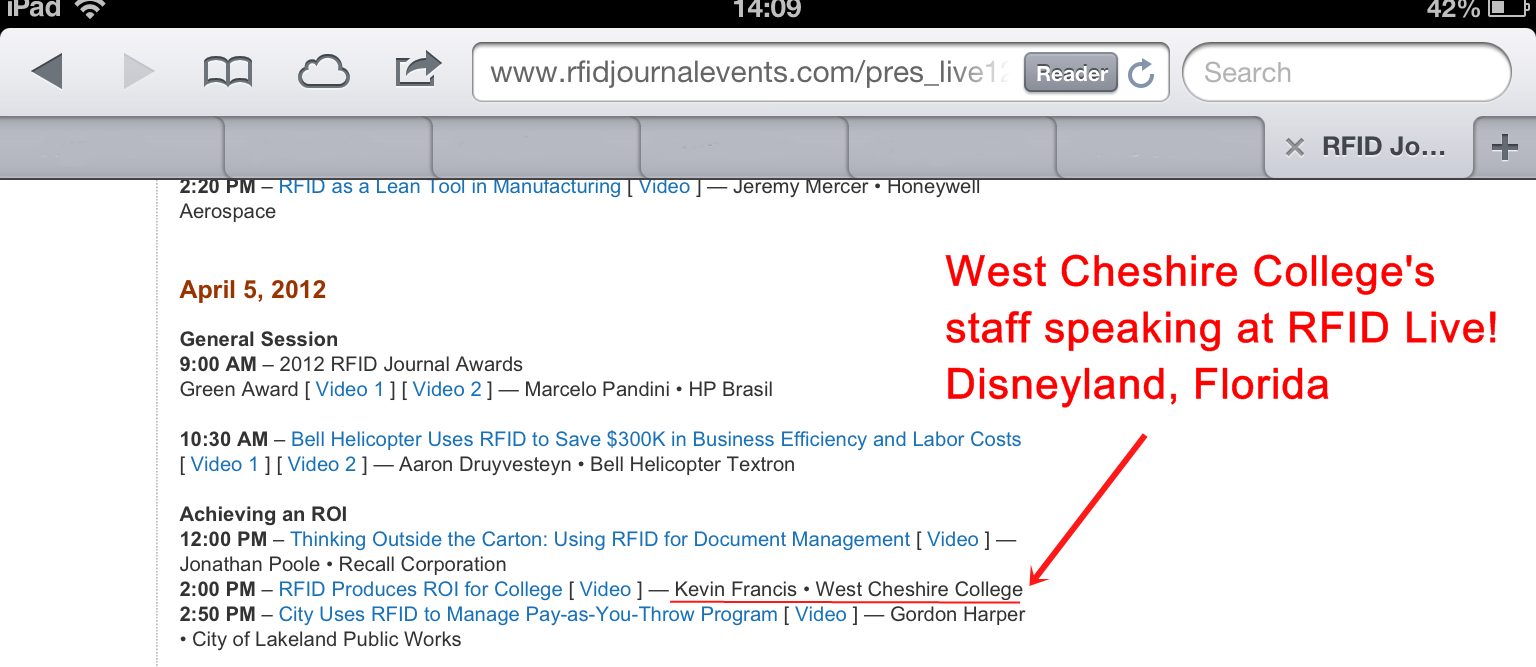





 Against RFID in schools