Tag Archives: Tracking children

RFID “ensures foolproof safety” for kids

RFID (CCTV and GPS tracking) ensures “foolproof safety” of children?  Really?
A claim made as Dubai launches it first phase of RFID tracking children on school buses with 3,200 buses transporting around 170,000 children “In the second phase, the entire fleet will be equipped with CCTV cameras and live communications system.” …with sound bite transmitting and GPS on the buses too – no expense spared for the kids in Dubai.

RFID vendors and government employees may claim that the technology is capable of a lot of things to sell it to us but that it “ensures foolproof safety” of children on a school bus is, in my humble opinion, going a step too far.

The one claim that can be made about RFID (and other technologies) use in this circumstance, is that using this technology to track children without doubt erodes those children’s civil liberties and privacy. 

“This system ensures foolproof safety of our children who are the future of our country and implementation of such an advanced programme reflects on the importance the government gives to the issue of children’s safety,”

While Al Qutami’s, the Minister for Education, intentions are admirable to keep children safe, surveilling them to this point is not a “foolproof” answer.

RFID – Schools must “consult fully with parents and pupils”

There is no law against tracking people in the UK however in order to do so the person who is being tracked must give Data Protection Acttheir consent for the tracking to be legal.

In the UK Schedule 1 of the Data Protection Act 1988 (DPA) states that “Personal data shall be processed fairly and lawfully” .  One aspect of lawfully processing data is the area of consent, covered in Schedule 2 of the DPA.  The first point in Schedule 2 is that the Data Controller (the school) has to gain the consent of the Data Subject (the pupil) in order to process information about them. “The data subject has given his consent to the processing.”

Tracking children in education with a real time location system (RTLS) using RFID tags absolutely falls under this legislation.

An email received from the Department of Education states the following:

Thank you for your email of 1 January 2013 addressed to the Secretary of State, with enclosures, about the implications of the use of Radio Frequency Identification Technology.  I have been asked to reply. [Case Ref 2013/0000789]

As you will be aware, schools and colleges are Data Controllers in their own right, and as such, must comply with the data protection principles set out in the Data Protection Act 1998.  For example, the first data protection principle requires that personal data must be used fairly and lawfully and that one of the conditions in Schedule 2 to the Data Protection Act must be met.  These include: obtaining the consent of the data subject; compliance with legal obligations; performance of contractual obligations; and the processing being necessary for the purposes of legitimate interests of the data controller.  I understand from your email that you have also been in contact with the Information Commissioner’s Office (ICO) and I would suggest that the ICO would be the appropriate body for advising on the particular case you have pursued.

As with the introduction of parallel systems such as CCTV, this Department would look to schools and colleges to consult fully with parents and pupils before implementing this kind of technology.

UK Department of Education – tracking children in education with RFID:

“…schools and colleges to consult fully with parents and pupils before implementing this kind of [RFID] technology“.

RFID – “It’s going to make you sick.”

nav-logo-small-newAt the Texas House of Representatives House Bill 101 was heard yesterday, 19th March 2013.  The audio/video can be found here 2 hours 45 minute in.

From My San Antonio – Andrea Hernandez, one of the students that refused to carry the tracking RFID and was subsequently expelled from John Jay High School, ” told legislators Tuesday that she became ill because of radiation from the tags in other students’ IDs.
 “It’s like being in an X-ray machine for eight hours,” Andrea Hernandez said. “It’s going to make you sick.”” 

Incredibly the vendor of the active RFID 433MHz tags that the students wear, Michael Wade, stated that “said they [RFID tags] do not produce any radiation. – “None at all,” he said.”

…move along people, clearly nothing to see here then?

Michael Wade is uninformed.  Radio frequency is electromagnetic radiation.   The following is taken from this EU document “Is RFID safe in the workplace” and talks about the effects of RFID radiation.

Radio communications and microwave frequencies are known as radiofrequency, which fall within the kHz to GHz range.  In the case of RFID, the frequencies used are in the order of 145 kHz, 13.56 MHz, 800-900 MHz and 2.4 GHz.  There are two different kinds of electromagnetic radiation. Depending on their major effects, electromagnetic fields can be divided into ionizing radiation and non-ionizing radiation.  As radiofrequency photon energy up to 300 GHz is not high enough to break these bonds, these kinds of electromagnetic fields are known as Non-Ionizing fields. Fields with frequencies above this limit are known as Ionizing Electromagnetic Fields.  (433MHz tags used at John Jay)

Ionization is a process that breaks the atom-electron bond, thus creating molecules without sufficient electrons to achieve a neutral charge. This causes molecular changes that may produce biological damage, including changes in DNA.

Also this article from the World Health Organisation about mobile phone frequencies, 450 and 2700 MHz, operating near the 433MHz RFID tag frequency that John Jay High use.

Radio frequency radiation and health effects is too large a topic to be covered here in any depth but there is a mounting body of evidence to suggest that electromagnetic frequencies can have an effect on health – this is from radiation.  So statements from RFID vendors, that could be described as misleading and uninformed, need a little more research.  The health effects of active and passive RFID are known.   With good evidence to suggest radio frequencies can harm humans, here are just a handful of excellent websites dealing with this topic:

Contactless RFIDhttp://www.radiationresearch.org/
http://stopsmartmeters.org/
http://www.wifi-in-schools-australia.org/
http://wiredchild.org/

Unfortunately these frequencies are invisible and we have no knowledge of what we are accumatively exposed to.  Therefore eliminating one less potential health hazard from our lives by not wishing to carry an active RFID tag could considered a prudent action to take.

So though individuals may choose not to consent to using RFID due to personal, spiritual, privacy/civil liberties concerns, it may appear that there is no choice whether or not to participate in the electrosmog that comes from others use of, RFID, radio frequencies technologies.


Missouri bill proposes prohibiting RFID in schools

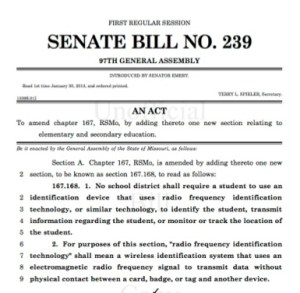
Missouri SB239USA –  Missouri Education Watchdog reported that Senator Ed Emery filed “a bill in Missouri that would not allow such practices as RFID tracking of students or Polar Go Fit bracelets for tracking information.”

The Bill SB239Prohibits school districts from requiring a student to use an identification device that uses radio frequency identification technology to transmit certain information’

This bill joins the other three current bills in Texas put forward prohibiting the use of RFID with children/students in US schools.

West Cheshire College stops tracking students with RFID

West Cheshire College, UK, have stopped tracking their students with active RFID tags since using the technology from 2010.
Active location tracking RFID West Cheshire College

On the 26th of February a complaint was made to the Information Commissioner’s Office (ICO) concerning the college’s refusal to answer a Freedom of Information request about consent and civil liberties regarding using active RFID tags to trace students movements around West Cheshire College campuses at Handbridge and Ellesmere Port.

On 27th February the college states they do not use the RFID:  As the trial has now concluded, all RFID tags are inactive and have been recalled.” 

On 18th February West Cheshire College, in an FOIR reply, appears still to be using a student RFID location system and on 27th February, 9 days later, the college states it has ceased using the ultra wideband RFID location system.

A RFID system so excellent that the college sent an employee to Florida last April, 2012, to lecture the RFID industry on the Return On Investment (ROI) the RFID provided for the college (see 2pm on April 5th).  However there are unanswered Freedom of Information requests regarding how the RFID was funded, if indeed the college has ever paid for the system.  This then presents the question as to why would West Cheshire College send an employee to Florida, USA, to lecture the RFID industry on a new ultra wideband RFID standard on a return on investment that the college never invested in?

From West Cheshrie College presenting a Return On Investment (ROI) presentation in April 2012 in Florida, to scrapping it in February 2013 it would seem the college has also scrapped all information whatsoever on the groundbreaking industry standard RFID  they have had in the college since 2010.

On the 27th February 2013, a day after a complaint to the ICO, West Cheshire College offered a late reply to the Freedom of Information request asked on 10th December 2012 regarding consent and civil liberties.  After the college did a “search for information” it can uncover “no information” at all on how consent was gained from students, whether the college did a Privacy Impact Assessment to access the RFID or how the college could use a RFID for registration when “The technology is not used for tracking of individual students“.  Maybe that is why the RFID was scrapped – how can a system that does not individually track children work for registration? …and it took them 2 years to come to that conclusion?  (Really?)  There are anomalies in all this that seem not to add up.

One could draw an opinion that West Cheshire College are evading questions on why an unstandardised active RFID location system has been used to track children for over 2 years.  There are unanswered questions on how consent was gained and how the college, days after scrapping the technology, seem to have completely expunged all records of the ultra wideband RFID and in fact have no evidence of the RFID real time location system used there.

The Information Commissioner’s Office is now handling the complaint of how West Cheshire College managed their legal obligation to give information under the Freedom of Information Act.  This active type RFID technology has the capacity to be used covertly and the potential for lack of transparency by educational establishments using a real time location system is completely plausible.

Contactless RFIDDifferent people have differing levels of privacy.  If you or your child are wearing or carrying a card or tag that communicates remotely to a system and you have concerns how ‘smart’ or ‘contactless’ technology works – ask questions.  We all know data gathering is vast in today’s age.  Making sure you are aware of who is accessing your data is prudent, none of us truly know where our information may end up, who views it and how it may be used for or against us.